Pests
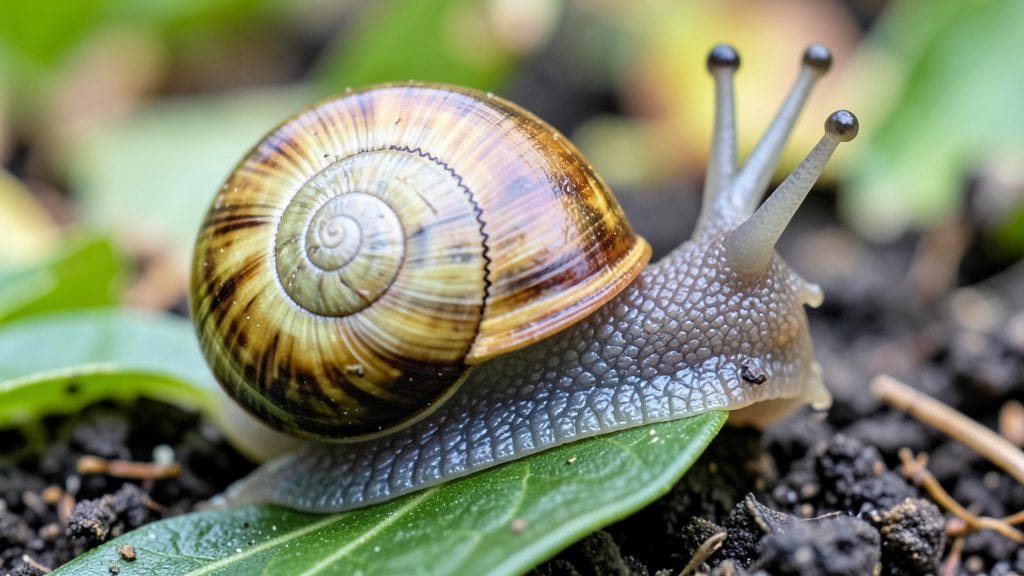
Understanding garden snail anatomy shows why these creatures thrive in gardens, featuring a coiled shell for protection, sensory tentacles for navigation, and a muscular foot for movement. Their mucus trail serves as both a lubricant and defensive barrier, while specialized mouthparts and a lung system allow them to adapt to both moisture and air.
Garden snails have evolved some fascinating adaptations that make them resilient survivors.
Their coiled shells aren't just decorative—they're made of calcium carbonate, which hardens as the snail grows, creating a fortress against predators and harsh weather. 💫 The two pairs of tentacles (longer ones for vision and shorter ones for sensing air currents) help them detect threats from afar, while their radula—a toothy tongue—lets them scrape through tough plant material with surprising efficiency.
This combination of features explains why they're such persistent pests in gardens but also why they've survived for millions of years.
What's particularly interesting is how their anatomy reflects their lifestyle. The mucus trail isn't just slippery—it contains antimicrobial compounds that deter bacteria and fungi, while also helping them glide silently over surfaces. Their lung system means they can breathe outside water, though they still need moisture to stay active.
This dual capability is what lets them thrive in garden beds where other mollusks would struggle.
💡 In This Article
- How Garden Snail Shells Protect Against Predators
- Identifying Key Snail Body Parts for Gardeners
How garden snail shells protect against predators
A garden snail's shell is a marvel of biological engineering, constructed primarily from calcium carbonate (90-95% of its composition) arranged in a spiral pattern that grows with the snail. This coiled structure isn't just decorative—it's a defensive fortress with a 360-degree protective barrier that encases the entire soft body.
The shell's weight (typically 10-20% of the snail's total body weight) makes it difficult for predators to flip them over, while the tight spiral design minimizes surface area exposed to attacks. 🔥
The shell's growth follows precise mathematical patterns called logarithmic spirals, similar to the golden ratio (φ ≈ 1.618), which provides optimal strength while using minimal material. Each new layer, or whorl, is secreted by the mantle—a specialized tissue lining the shell's interior.
This layered structure makes the shell 10-15 times harder than the snail's soft body tissues, acting like armor against bird beaks, insect mandibles, and even small mammal teeth. The shell's porosity also allows gas exchange, ensuring the snail doesn't suffocate while retracted.
When threatened, a snail's first defense is rapid retraction—its muscular foot contracts to pull the entire body into the shell within 1-2 seconds. The mantle then secretes a calcareous epiphragm, a temporary door made of hardened mucus and calcium that seals the shell's opening.
This epiphragm acts like a biological padlock, blocking predators from reaching the vulnerable soft tissues inside. Interestingly, this sealing mechanism is so effective that some snails can survive for weeks without food or water if their shell remains intact. 💫
The shell's color and texture also play subtle but crucial roles in defense. Many garden snails have earth-toned shells (browns, grays) that blend into garden soil, while others develop algae or lichen growths that further camouflage them.
The shell's microscopic ridges create irregular light reflections, making it harder for predators to judge distance when attempting a strike. Evolutionary studies show that snails in areas with higher predation pressure develop thicker, more reinforced shells as a direct adaptive response.
What's particularly fascinating is how the shell's structure reflects the snail's age. Each complete whorl represents roughly one year of growth, with visible growth lines marking seasonal changes. This means a snail with 5 whorls is typically 5 years old—an impressive lifespan for such a small creature.
The shell's continuous growth also allows it to repair damage from minor cracks or predator attacks, though severe breaks can be fatal if they expose too much of the soft body. 🌟
This defensive system explains why garden snails are such persistent survivors. Their shells provide physical protection, camouflage, and environmental resilience—allowing them to thrive in gardens, forests, and even urban environments where they face constant predation pressure.
The combination of their armored shell, rapid retraction, and sealing ability creates a nearly impenetrable defense system that's been perfected over 50-60 million years of evolution.