Tools
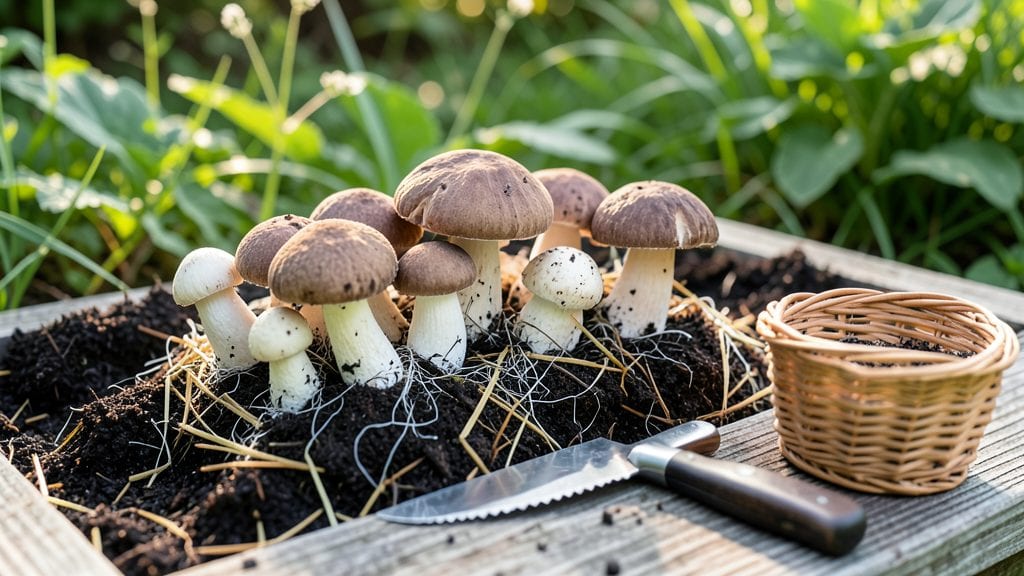
To identify garden mushrooms correctly, you’ll need to know which ones are safe—and which could be deadly, so here’s how to spot the difference. ✨ I’ve spent years studying the subtle differences between harmless button mushrooms and their deadly look-alikes, and I’m sharing the key visual clues that save you from costly (or worse) mistakes.
The wrong ID could mean poisoning pets or people, so knowing gill spacing, cap texture, and spore print color isn’t just smart—it’s essential.
Start with the basics: edible mushrooms like button varieties have smooth caps, white gills, and grow in clusters on soil or wood. Toxic look-alikes often have yellowing gills, a volva (cup-like base), or a ring on the stem—details most foragers overlook.
I’ll walk you through how to test for bruising, smell, and even taste (with extreme caution) to narrow it down. Grab a magnifying glass and a white plate for spore prints—these simple tools make all the difference.
By the end, you’ll spot the warning signs of death caps or false morels before they fool you. The goal isn’t just to eat safely—it’s to protect your garden’s ecosystem. Some mushrooms are beneficial, breaking down organic matter, while others invite pests.
You’ll learn when to leave them be, when to harvest carefully, and when to call an expert. Confidence in ID means no more second-guessing every mushroom you see.
This guide works for backyard gardeners, urban foragers, and even curious kids (with supervision). Whether you’re dealing with a sudden mushroom boom after rain or just want to avoid accidental poisoning, these steps keep you covered. Let’s turn your garden into a safer, smarter foraging zone—one mushroom at a time.
What Triggers Mushroom Misidentification
Mistaking one mushroom for another—especially when it comes to garden varieties—can turn a harmless harvest into a dangerous gamble. But why does this happen so often? The answer lies in a mix of biological, environmental, and human factors that blur the lines between safe and toxic fungi.
Understanding these causes can help you sharpen your eye and avoid costly (or life-threatening) mistakes.
Many poisonous mushrooms share striking resemblances with their edible counterparts due to evolutionary convergence. Nature doesn’t always reward uniqueness—sometimes, survival depends on looking like something else. For example:
- False Morels (Gyromitra spp.) mimic true morels (Morchella spp.) but contain gyromitrin, a toxin that breaks down into deadly monomethylhydrazine (MMH)—the same compound used in rocket fuel. 🚀 The key difference? False morels have wrinkled, brain-like caps instead of the honeycomb ridges of true morels.
- Death Cap (Amanita phalloides) vs. Paddy Straw (Volvariella speciosa): Both have white gills and stipes, but the Death Cap’s volva (cup-like base) and ring that tightens with age are dead giveaways. Yet, in dim light or when bruised, these features can fade, making them nearly identical to harmless Volvariella species.
Actionable Tip: Always check for microscopic spores (use a handheld loupe) and note habitat preferences—Death Caps love oak trees, while Paddy Straw thrives in disturbed soil. 🔍
Mushrooms don’t grow in isolation—they adapt to their surroundings, and some species intentionally exploit similar conditions to confuse foragers. Here’s how:
| Factor | Edible Mushroom | Toxic Look-Alike | Key Difference |
|---|---|---|---|
| Moisture & Decay | Chanterelles (Cantharellus) | Jack-O’-Lantern (Omphalotus illudens) 🎃 | Chanterelles have forked, blunt gills; Jack-O’-Lanterns have true gills and glow faintly in the dark. |
| Lawn & Garden Soil | Button Mushrooms (Agaricus bisporus) | Destroying Angel (Amanita bisporigera) | Destroying Angel has a sack-like volva at the base and no brown scales on the cap. |
| Tree Roots (Especially Oak) | Chicken of the Woods (Laetiporus) | False Chicken of the Woods (Hapalopilus nidulans) | True Laetiporus is bright orange when young; the false version is pale yellow-brown and harder to tear. |
Why It Matters: Some toxic mushrooms, like the Omphalotus species, only fruit in late summer/fall—right when chanterelles peak. Never assume a mushroom is safe just because it’s in season. 🌿
Even experienced foragers fall victim to cognitive traps that distort perception:
- The "Field Guide Effect": Relying solely on photos or outdated guides can lead to confirmation bias—seeing what you expect to see, not what’s actually there. For example, a bruised Amanita might lose its white gills, making it look like a harmless Lepiota.
- Size and Age Deception: Young specimens of toxic mushrooms (like Cortinarius rubellus) can resemble edible Russula species until they mature. A 1-inch cap might be safe; a 4-inch cap could be deadly. 📏
- Sensory Override: Some toxic mushrooms (e.g., Gyromitra esculenta) taste mild when cooked, lulling foragers into a false sense of security. Never eat a mushroom based on taste alone. 🚫👅
Pro Tip: Use the "Three-Step Test" before identifying:
- Observe (color, shape, habitat).
- Smell (some toxic mushrooms have a chemical or foul odor).
- Touch (texture—slimy = suspect; dry and fibrous = often safe). Then cross-reference with a verified expert or spore print kit. 🔬
Mushrooms are highly localized—what’s safe in the Pacific Northwest might be lethal in the Southeast. Climate shifts, introduced species, and even microclimates within your garden can alter mushroom growth patterns:
- Invasive Species: The Amanita phalloides (Death Cap) has spread across North America due to global trade and climate change. It now thrives in urban gardens and disturbed soils, areas where foragers least expect it.
- Hybridization: Some mushrooms cross-pollinate with toxic relatives, creating intermediate forms that defy traditional identification. For example, Agaricus species can hybridize, producing partially toxic specimens.
- Phenocopying: Environmental stress (drought, pollution) can cause edible mushrooms to develop toxic traits or vice versa. A Lactarius mushroom might bleed milk (a safety feature) in one region but not in another.
Actionable Solution:
- Join local mycology groups to learn region-specific threats.
- Document your finds (photos, GPS, habitat notes) and compare them with verified databases like iNaturalist.
- Avoid "first-time" mushrooms—stick to species you’ve positively ID’d with an expert at least 3 times. 📸🔍
Fixing Common Mushroom Misidentifications
Mistaking garden mushrooms for their toxic look-alikes can turn a fun foraging trip into a dangerous gamble. But with the right approach, you can confidently distinguish safe varieties from harmful ones—without needing a PhD in mycology.
Below, we break down the most common causes of misidentification and provide practical, step-by-step solutions to avoid costly (or deadly) errors.
1.
The "Death Cap" vs. "Paddy Straw" Mix-Up Cause: Both mushrooms have white gills and grow in similar environments, but one is deadly while the other is edible (and delicious). Fix: - 🔍 Check the cap: Death caps (Amanita phalloides) have a smooth, olive-green or yellowish cap when young, while paddy straws (Volvariella volvacea) have a tan or brown cap with a scaly texture. - 🧅 Look at the stem: Death caps have a bulbous base with a sac-like "volva" (a cup-like remnant of the universal veil).
Paddy straws have a ring on the stem but no volva. - 🌱 Grow them separately: Paddy straws thrive in compost-rich beds, while death caps prefer wooded areas with oak or pine trees.
💡 Prevention Tip: Never eat a mushroom unless you’ve 100% confirmed its identity—when in doubt, throw it out!
2.
False Morels vs. True Morels Cause: False morels (Gyromitra spp.) resemble edible morels (Morchella spp.), but the former can cause severe liver damage. Fix: - 🧬 Inspect the cap: True morels have a honeycomb-like, pitted surface, while false morels have a wrinkled, brain-like texture. - 🍄 Check the stem: False morels often have a smooth or slightly hairy stem, whereas true morels have a fibrous, hollow stem. - 🚫 Avoid if bruised: False morels discolor when cut—a red flag for toxicity.
💡 Prevention Tip: Only forage morels in early spring when they’re fresh. Avoid any that smell foul or rotten.
3.
The "Destroying Angel" vs. "Button Mushroom" Blunder Cause: Destroying angels (Amanita bisporigera) are one of the deadliest mushrooms, yet their white, button-like caps resemble store-bought buttons. Fix: - 👶 Look for a "skirt" and "volva": Destroying angels have a white, sac-like volva at the base and a ring (skirt) on the stem.
Buttons (Agaricus bisporus) have no volva and a brownish cap when mature. - 🌿 Check the habitat: Destroying angels grow under oak or pine trees, while buttons thrive in grass or compost piles. - 🚨 Never eat white mushrooms from the wild unless you’re absolutely certain—store-bought buttons are safe, but wild ones are Russian roulette.
💡 Prevention Tip: If you see a perfectly white mushroom with no gill color changes, do not touch it.
4.
The "Jack-O’-Lantern" vs. "Chanterelle" Confusion Cause: Both are orange and prized by foragers, but the false chanterelle (Hygrophoropsis aurantiaca) can cause stomach upset. Fix: - 🧂 Taste test (carefully!): True chanterelles (Cantharellus spp.) have a fruity, peppery flavor, while false chanterelles taste mild and bland. - 🍄 Examine the gills: Chanterelles have forked, blunt ridges (not true gills), while false chanterelles have thin, true gills. - 🌲 Check the habitat: True chanterelles grow under hardwood trees (oak, beech), while false chanterelles appear in coniferous forests or grassy areas.
💡 Prevention Tip: If you’re unsure, take a spore print (place the cap gill-side down on paper overnight) to compare with known samples.
5.
The "Shaggy Mane" vs. "Death Cap" Resemblance Cause: Both have white gills and grow in similar conditions, but one is highly toxic. Fix: - 🧠 Observe the cap texture: Shaggy manes (Coprinus comatus) have a velvety, shaggy cap, while death caps have a smooth, almost greasy surface. - 🕰️ Note the lifespan: Shaggy manes dissolve into black ink-like liquid when mature—death caps never do this. - 🌿 Check the base: Shaggy manes have a fluffy, white base, while death caps have a bulbous, sac-like volva.
💡 Prevention Tip: If a mushroom melts into black liquid, it’s safe—but only if confirmed as shaggy mane.
No matter the mushroom, follow these non-negotiable steps:
- 📖 Carry a field guide (or app) – Use iNaturalist, Mushroom Identifier, or a physical guidebook for cross-referencing.
- 👨🔬 Take photos from all angles – Capture the cap, stem, gills, and base in natural light.
- 🧪 Never eat alone – If you’re unsure, consult an expert or take a sample to a mycology club.
- 🚫 Avoid mushrooms with: - White gills (unless confirmed safe) - A volva or ring (unless it’s a known edible like Amanita caesarea) - Red or yellow caps (many are toxic)
- 🍽️ Cook thoroughly – Even some safe mushrooms (like morels) must be well-cooked to avoid digestive issues.
Final Thought: 🌱 When in doubt, skip it out. The joy of foraging is in the hunt, not the risk. With these fixes, you’ll spot the good, avoid the bad, and enjoy the wild harvest safely!
Frequently asked questions about garden mushrooms
How do I tell if a garden mushroom is safe to eat?
Never eat a wild mushroom unless you’ve 100% confirmed its identity with an expert or verified field guide. Look for key features like gill color, cap texture, and habitat. For example, button mushrooms have brown caps and grow in soil, while death caps have a sac-like base and white gills. When in doubt, throw it out!
What are the most dangerous mushrooms that grow in gardens?
The death cap (Amanita phalloides) and destroying angel (Amanita bisporigera) are the deadliest. They resemble edible button mushrooms but contain toxins that cause liver failure. Other risky look-alikes include false morels (wrinkled caps) and Jack-O’-Lanterns (false chanterelles). Always check for a volva (cup-like base) or gill structure to rule out danger.
Can I use a spore print to identify mushrooms?
Yes! Place the cap gill-side down on white paper overnight in a dark, humid container. The spore print color helps narrow it down—for example, white spores often indicate Amanita species (some deadly), while brown spores suggest Agaricus (like buttons). Compare your print to verified samples in a field guide.
What should I do if I accidentally pick a toxic mushroom?
Don’t eat it! Take a photo, note its location, and consult a mycology expert or local poison control center. If you’ve already ingested it, seek immediate medical help—even small amounts of death cap can be fatal. Save a sample (uncooked) for testing. Never rely on taste or smell alone.
Are there any safe mushrooms I can grow in my garden?
Yes! Oyster mushrooms and shiitake are beginner-friendly and thrive in gardens. Button mushrooms (Agaricus bisporus) also grow well in compost beds. Avoid wild harvesting—stick to cultivated varieties or those positively ID’d by experts. Start with kits for safe results.